Reducing Flanges
One flange, two sizes. The bolt pattern of the larger pipe, the bore of the smaller one. Weld neck, slip-on, threaded and socket weld per ASME B16.5, in carbon, stainless and alloy.
The concept
The larger bolt pattern, the smaller bore
A reducing flange takes the flange ring of one pipe size and the bore of a smaller one. The outside diameter, the thickness, the bolt circle, and the number and size of the bolt holes all belong to the larger size. The bore, and on a weld neck the hub diameter and length through hub, belong to the smaller size.
The mental model that makes this stick: it bolts to a larger flange and welds to a smaller pipe.
A reducing flange does not reduce the pipe. It terminates a smaller line in a larger bolt pattern. The pipe on the welded side stays small, and the pipe on the bolted side stays large. What has been saved is a separate reducer fitting and one weld.
Texas Flange has machined these since 1986, in every pattern ASME B16.5 recognises and in sizes and materials the tables do not cover.
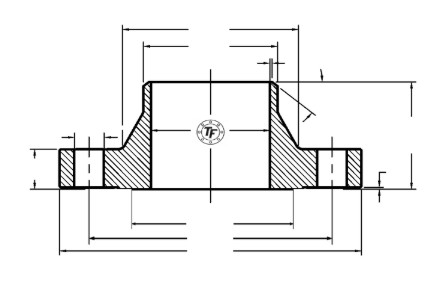
ASME B16.5
What changes, and what does not
This is the whole standard treatment in one table, and it answers most reducing flange questions on its own.
| Dimension | Taken from | Why |
|---|---|---|
| Flange outside diameter | Larger size | It has to mate with the larger flange |
| Bolt circle diameter | Larger size | Same reason |
| Number and size of bolt holes | Larger size | Same reason |
| Flange thickness | Larger size | The bolt load and moment arm belong to the larger bolt circle |
| Facing, raised face or flat | Larger size | The gasket seats on the larger pattern |
| Bore | Smaller size | It has to accept the smaller pipe |
| Hub diameter, weld neck | Smaller size | The hub has to match the smaller pipe OD for the butt weld |
| Length through hub, weld neck | Smaller size | Follows the smaller size hub geometry |
The thickness point surprises people. A reducing flange is not thinned down to suit the smaller bore. It keeps the full thickness of the larger size, so it is heavier than the small-size flange it replaces, not lighter. On large sizes that extra weight is occasionally the deciding argument for using a reducer and a standard flange instead.
Product range
Reducing flange types
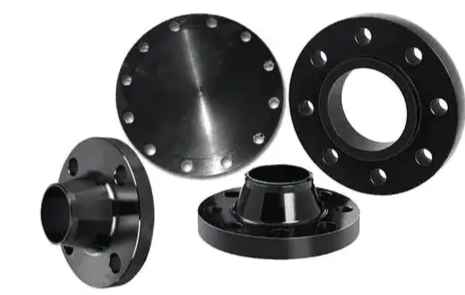
Reducing slip-on
The most common and the least troublesome. The bore is sized for the smaller pipe, which slides in and is welded inside and out. No hub to worry about, so the size drop is limited only by the material left around the bore.
Reducing weld neck
The demanding one. The hub must match the smaller pipe OD and schedule for a full penetration butt weld, while the ring stays the larger size. The transition between the two is where the engineering lives.
Reducing threaded
Tapped for the smaller pipe size to ASME B1.20.1. Small bore utility and instrument work, and useful on retrofits where welding is not permitted.
Reducing socket weld
A socket bored for the smaller pipe with a fillet weld at the hub. Small bore work where a threaded joint is not acceptable.
Reducing lap joint
A loose backing ring on the larger pattern behind a smaller stub end. Lets the bolt holes be rotated into line and keeps the alloy in the wetted part only.
No reducing blind
A blind flange has no bore, so there is nothing to reduce. If you need to blank a larger pattern, that is simply a blind flange of the larger size.
Use one when
- You are tying into an existing bolt pattern. The mating flange is already in place and nobody is redrilling it.
- Space is tight. A reducer plus a flange needs axial length a reducing flange does not.
- You want to delete a weld. One less joint to make, inspect and radiograph.
- Equipment nozzle mismatch. A pump, vessel or valve has a larger flange than the line connecting to it.
- The service is undemanding. Low velocity, clean fluid, no pressure drop budget, no cyclic duty.
Do not when
- Velocity is high. The abrupt step generates turbulence and erodes.
- It is pump suction. The pressure drop and turbulence at the step can push you into cavitation and NPSH trouble.
- The fluid carries solids. An abrupt step in slurry service is an erosion site.
- You are metering. Flow measurement needs a developed velocity profile. A step upstream destroys it.
- Pressure drop is budgeted. Sudden expansion and contraction losses are real and calculable.
- The drop is more than two sizes. Use a reducer.
The comparison in full: reducing flange vs pipe reducer.
Quoting
What to put on the RFQ
A reducing flange line item has two sizes on it, and leaving either ambiguous is the usual cause of a wrong part. State both, in order, and say which is which.
- Both nominal sizes. Flange size first, then bore size. For example, 8 inch flange with 6 inch bore, not just "8 by 6".
- Pressure class, which belongs to the larger size.
- Flange type. Reducing weld neck, slip-on, threaded, socket weld or lap joint.
- Facing. Raised face, flat face or ring joint, and the finish.
- Schedule or wall thickness of the smaller pipe, so the bore and the hub are right. This is the most commonly omitted item and on a weld neck it is essential.
- Material grade and specification.
- Design pressure, temperature and fluid, so we can tell you if the abrupt transition is going to be a problem.
- Certification, MTRs, spec revision, witness, and any domestic origin requirement.
If you are matching an existing flange, send the outside diameter, bolt circle, hole count, hole size and thickness, plus the OD and wall of the pipe that has to weld into it. That is enough for us to identify the pattern and confirm the reduction is sound.
Common questions
What is a reducing flange?
A single flange that carries the outside diameter, thickness and bolt pattern of one pipe size, and the bore of a smaller one. It bolts to a larger flange and welds to a smaller pipe. It lets you terminate a smaller line in a larger bolt pattern without a separate reducer and an extra weld.
Is a reducing flange the same as a reducer?
No, and confusing them causes real problems. A reducer is a pipe fitting that changes the pipe size over a tapered length, giving a gradual flow transition. A reducing flange changes size abruptly at the flange face and does not change the pipe size at all, it just terminates smaller pipe in a larger flange. Where flow matters, those are very different parts.
How many sizes can a reducing flange drop?
Two nominal sizes is the figure most shops work to as good practice. Past that there is progressively less material to support the hub on a weld neck, and the flow transition becomes severe. It is a matter of practice and engineering judgement rather than a single published number, so expect to justify a larger drop, and expect the better answer to be a reducer with a standard flange.
Does a reducing flange get thinner because the bore is smaller?
No. It keeps the thickness of the larger size. The bolt loads and the moment arm belong to the larger bolt circle, so the flange has to be built for the larger size. That makes a reducing flange heavier than the small-size flange it replaces, and that weight is sometimes the reason a designer chooses a reducer instead.
Which flange types are available as reducing?
Weld neck, slip-on, threaded, socket weld and lap joint. Slip-on and threaded are the most common and the least troublesome. A blind flange has no bore, so there is no such thing as a reducing blind.
When should I not use a reducing flange?
When the flow cares. High velocity service, pump suction where cavitation is a risk, slurry or anything abrasive, metering runs that need a developed profile, and lines where pressure drop is being counted. The abrupt step is the problem in every one of those cases. Use a reducer and a standard flange.
Reducing flanges, quoted fast
Give us both sizes, the class and the schedule of the smaller pipe. If the reduction is aggressive or the service is demanding, we will say so before you buy it.
Send the print, or send the size, class and grade. Texas Flange quotes quickly.
Request a QuoteOr call 281-484-8325 and ask for the reducing flanges desk.